
If your current tubing is swelling, hardening, cracking, discoloring, or becoming brittle after repeated exposure to chemicals, the problem may not be the process itself—it may simply be the wrong tubing material.
Choosing tubing for chemical transfer is not only about whether a material can survive contact with a chemical for a few hours. In industrial applications, the tubing may be exposed to acids, alkalis, solvents, cleaning agents, fuels, or other aggressive fluids continuously, sometimes under elevated temperatures or pressure.
This is why PTFE tubing is widely considered when conventional rubber, PVC, nylon, silicone, or other polymer tubing cannot provide sufficient chemical resistance.
But how chemically resistant is PTFE? Can PTFE tubes handle strong acids? What about solvents, alkalis, alcohols, fuels, or oxidizing chemicals? And when does it make sense to replace your existing tubing with PTFE?
This guide explains the chemical resistance of PTFE tubes, the chemicals they can commonly handle, their limitations, and the key factors buyers should consider before selecting PTFE tubing for chemical service.
Is PTFE Tubing Resistant to Most Chemicals?
Yes. PTFE (polytetrafluoroethylene) is resistant to an exceptionally broad range of chemicals, which is one of the main reasons it is widely used for demanding fluid-transfer applications.
PTFE has a highly stable molecular structure formed by strong carbon-fluorine bonds. This structure makes it extremely difficult for most chemicals to react with or attack the material.
As a result, PTFE tubing can generally resist many:
- ·Strong acids
- ·Strong alkalis
- ·Organic solvents
- ·Alcohols
- ·Hydrocarbons
- ·Oils
- ·Fuels
- ·Cleaning chemicals
- ·Corrosive process fluids
- ·Many oxidizing agents
For buyers, this means one PTFE tube can potentially replace several tubing materials that are each suitable for only a limited range of chemicals.
However, “chemically resistant” should never be interpreted as “universally compatible under every operating condition.” Chemical concentration, temperature, pressure, exposure time, permeability, and mechanical loading should all be considered before final material selection.
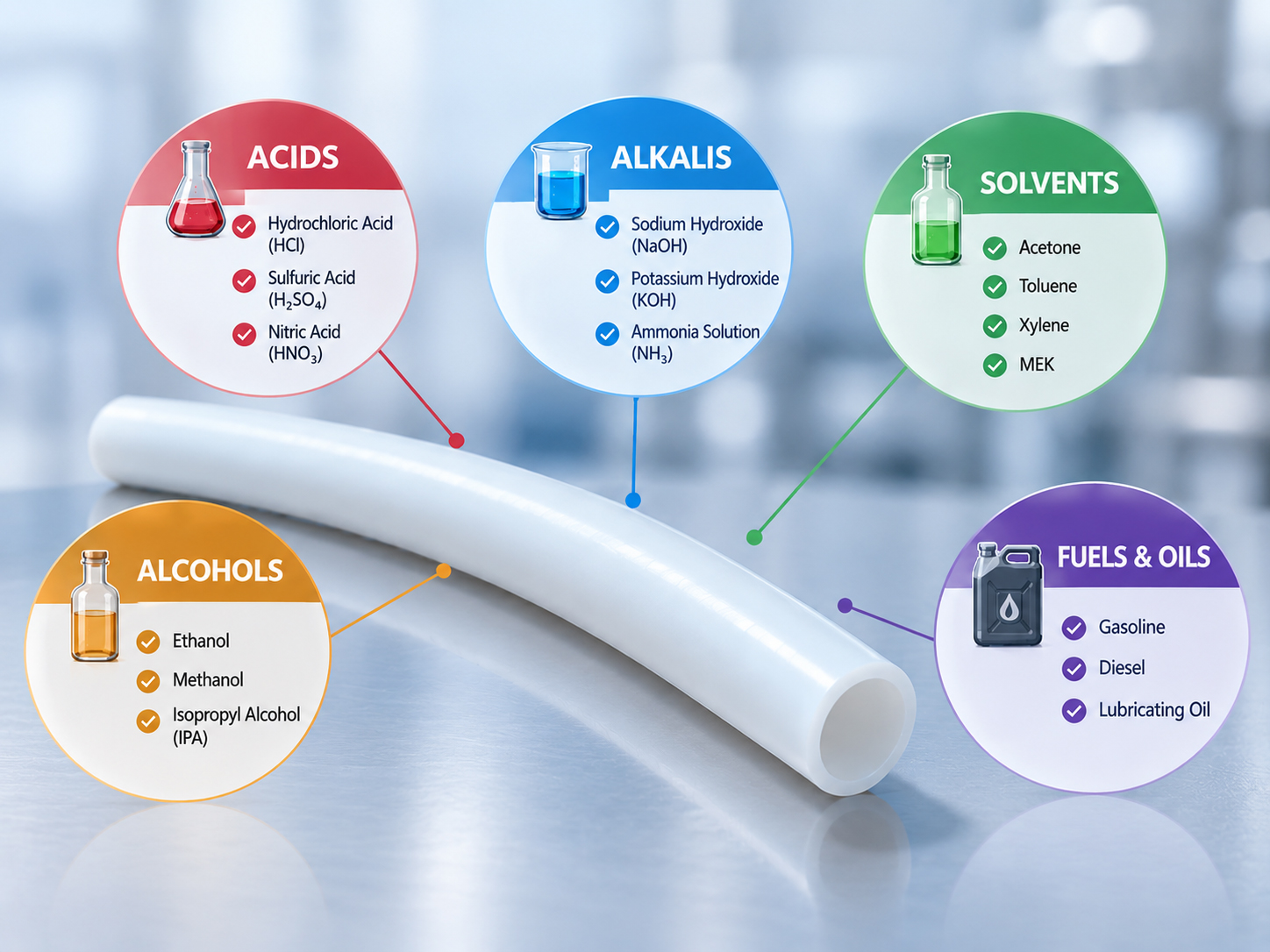
What Acids Can PTFE Tubes Handle?
One of the most common reasons companies choose PTFE tubing for chemical transfer is its excellent resistance to acids.
PTFE is commonly compatible with many aggressive acids, including:
| Chemical | General PTFE Compatibility |
| Hydrochloric Acid (HCl) | Excellent |
| Sulfuric Acid (H₂SO₄) | Excellent |
| Nitric Acid (HNO₃) | Excellent |
| Phosphoric Acid (H₃PO₄) | Excellent |
| Acetic Acid | Excellent |
| Citric Acid | Excellent |
| Formic Acid | Excellent |
| Chromic Acid | Generally Excellent |
This makes PTFE tubes particularly attractive for chemical processing equipment, laboratory systems, chemical dosing equipment, acid transfer lines, sampling systems, and industrial fluid-handling equipment.
For applications involving acids, alkalis, solvents, and other aggressive process fluids, choosing the right PTFE Tube for Chemical Processing can help improve chemical compatibility, system reliability, and long-term service life.
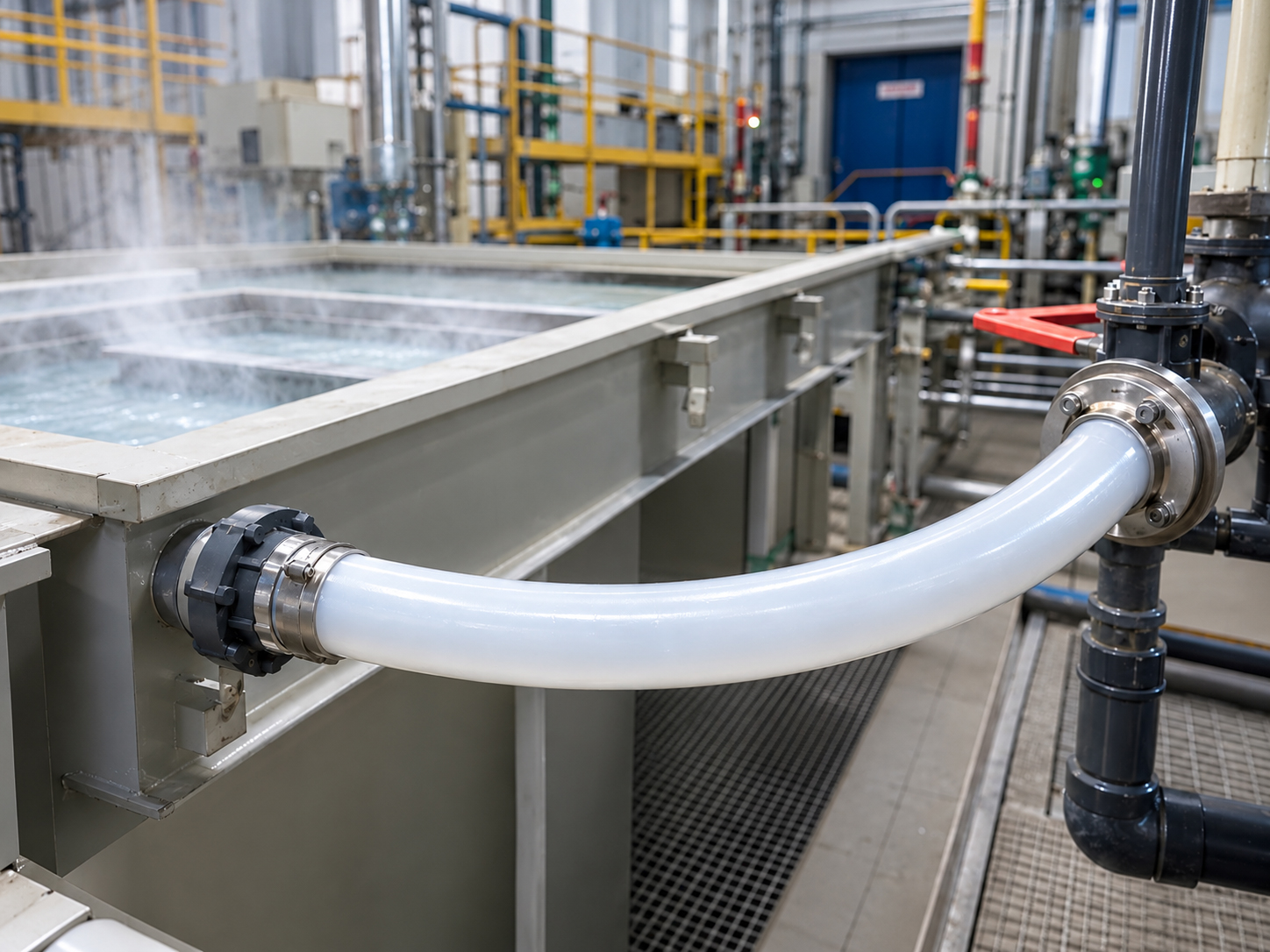
Can PTFE Tubes Handle Strong Alkalis and Caustic Chemicals?
PTFE is not only resistant to acids. It also provides excellent resistance to many strong bases and alkaline solutions.
Common examples include:
- · Sodium hydroxide (NaOH)
- · Potassium hydroxide (KOH)
- · Ammonia solutions
- · Calcium hydroxide
- · Many alkaline cleaning solutions
This broad acid-and-alkali resistance is important because some production lines handle multiple chemicals.
For example, a process may use an acidic chemical during production and an alkaline solution during cleaning. A tubing material that performs well with one but poorly with the other can become a maintenance problem.
PTFE provides a much broader compatibility window than many conventional tubing materials, reducing the need to select a different tube for every chemical environment.
Can PTFE Tubing Be Used With Solvents?
For many buyers, this is one of the most important questions.
PTFE tubing is highly resistant to a wide variety of organic solvents.
Examples can include:
| Solvent / Chemical Family | General PTFE Compatibility |
| Acetone | Excellent |
| Ethanol | Excellent |
| Methanol | Excellent |
| Isopropyl Alcohol (IPA) | Excellent |
| Toluene | Excellent |
| Xylene | Excellent |
| Hexane | Excellent |
| Ethyl Acetate | Excellent |
| MEK | Excellent |
| Many Chlorinated Solvents | Excellent |
This makes PTFE tubing for solvents useful in applications such as chemical transfer, analytical instruments, laboratory equipment, printing and coating equipment, semiconductor-related systems, and industrial processing machinery.
Many conventional polymers may soften, swell, lose strength, or extract unwanted substances after prolonged solvent exposure.
PTFE is much less susceptible to these problems.
That does not mean every solvent application is automatically suitable. Permeation can still be important, particularly with certain small-molecule fluids, gases, or demanding high-temperature applications.
Can PTFE Tubing Handle Alcohol, Oil and Fuel?
In many cases, yes.
PTFE has good compatibility with many:
- · Ethanol
- · Methanol
- · Isopropyl alcohol
- · Mineral oils
- · Lubricating oils
- · Hydraulic fluids
- · Gasoline
- · Diesel
- · Many fuel blends
This is one reason PTFE is commonly considered for automotive, fluid-transfer, lubrication, chemical-processing, and industrial equipment applications.
For fuel applications, however, another factor becomes important: electrostatic charge.
When certain fuels or solvents flow through a non-conductive PTFE tube, static electricity can potentially accumulate.
For applications where static discharge presents a risk, a conductive or antistatic PTFE inner tube may be more appropriate than standard non-conductive PTFE.
Buyers should therefore tell the manufacturer exactly what fluid will pass through the tube rather than simply requesting “PTFE tubing.”
Fortunately, Besteflon offers both standard PTFE tubes and conductive PTFE tubes for selection. If buyers are unsure which option to choose, they can simply contact our Besteflon sales representatives for a tailored solution.
Are There Any Chemicals PTFE Tubes Cannot Handle?
PTFE has one of the broadest chemical-resistance ranges among commonly used polymer tubing materials, but it is not completely universal.
Certain unusual and highly reactive chemicals can attack PTFE under specific conditions.
Important exceptions include:
Molten Alkali Metals
Molten or highly reactive alkali metals, such as sodium and potassium under certain conditions, can attack PTFE.
Elemental Fluorine Under Severe Conditions
Fluorine can react with PTFE under certain high-temperature or high-pressure conditions.
Certain Highly Reactive Fluorinating Agents
Some extreme fluorinating chemicals may not be suitable for PTFE.
These are relatively specialized environments and are very different from most conventional industrial chemical-transfer applications.
For typical acids, alkalis, solvents, oils, fuels, and industrial chemicals, PTFE remains one of the most chemically resistant tubing materials available.
Does Chemical Concentration Affect PTFE Tubing?
This is an important question when checking a PTFE tube chemical compatibility chart.
Chemical compatibility should not be judged only by chemical name.
For example:
“Sulfuric acid” is not enough information.
A tubing manufacturer may need to know:
- ·Chemical name
- ·Concentration
- ·Operating temperature
- ·Working pressure
- ·Continuous or intermittent exposure
- ·Required flow rate
- ·Tube size
- ·Whether the fluid is a mixture
- ·Required service life
A 5% solution operating at room temperature is very different from a concentrated chemical flowing continuously at elevated temperature.
PTFE generally maintains excellent resistance across a very broad concentration range, but providing complete operating information allows the supplier to evaluate not only chemical compatibility but also the overall suitability of the tubing system.
Does Temperature Change the Chemical Resistance of PTFE Tubes?
Temperature should always be evaluated together with chemical compatibility.
PTFE itself provides an unusually broad operating-temperature range. Depending on tube construction and application conditions, PTFE tubing can be suitable for approximately:
-65°C to +260°C (-85°F to +500°F)
This is a major advantage when a chemical process involves both aggressive media and elevated temperatures.
For example, another polymer tube might resist a chemical at 20°C but soften, swell, or lose mechanical strength when the same fluid reaches 100°C.
PTFE performs much better in many of these combined chemical-and-temperature environments.
However, increasing temperature can also influence:
- ·Permeation
- ·Pressure capability
- ·Creep
- ·Mechanical strength
- ·Fitting performance
- ·Service life
Therefore, maximum temperature should never be considered independently from pressure and chemical exposure.
PTFE vs PVC, Rubber, Silicone and Nylon: Which Is Better for Chemical Transfer?
If you are considering replacing your current tubing, chemical compatibility is often the first comparison to make.
| Tubing Material | Chemical Resistance | Temperature Capability | Solvent Resistance | Typical Limitation |
| PTFE | Excellent / Very Broad | Very High | Excellent | Higher initial cost, lower inherent flexibility than soft elastomers |
| PVC | Moderate | Low–Moderate | Limited for some solvents | Can soften or degrade with incompatible chemicals |
| Rubber | Depends heavily on compound | Moderate | Varies significantly | Swelling, aging and chemical-specific compatibility |
| Silicone | Moderate | High | Limited with many solvents/fuels | Permeability and chemical compatibility |
| Nylon | Moderate | Moderate | Application-dependent | Moisture absorption and limited resistance to some acids |
| PTFE | Suitable for a very broad range of aggressive media | Up to +260°C in appropriate designs | Excellent | Application conditions must still be verified |
There is no single “best tube” for every application.
If your process handles mild fluids at moderate temperatures, changing to PTFE may not be necessary.
But PTFE becomes particularly attractive when your existing tube repeatedly fails because of:
- ·Chemical corrosion
- ·Swelling
- ·Hardening
- ·Cracking
- ·Solvent attack
- ·High temperature
- ·Frequent tube replacement
- ·Contamination concerns
- ·Multiple chemical media in the same system
In those situations, the higher initial cost of PTFE tubing may be offset by longer service life and reduced maintenance.
Should I Replace My Existing Chemical Tubing With PTFE?
If you are reading this guide because your current tubing is failing, consider why it is failing before simply changing materials.
Your Current Tube Swells After Chemical Exposure
Swelling usually indicates that the tubing material is interacting with or absorbing the chemical.
PTFE’s chemical inertness can make it a much better option for many solvent and chemical applications.
Your Tube Becomes Hard or Brittle
Some elastomers gradually harden because of heat, chemical exposure, oxidation, or aging.
PTFE provides excellent aging resistance and does not rely on plasticizers to remain chemically stable.
Your Tube Cracks Near Hot Equipment
The problem may be a combination of chemical exposure and temperature.
PTFE’s broad chemical resistance combined with high-temperature capability makes it useful where both conditions exist simultaneously.
You Frequently Change Chemicals in the Same Equipment
This is another situation where PTFE can be valuable.
Instead of checking whether an elastomer is compatible with every new solvent, acid, or cleaning agent, PTFE provides a significantly broader chemical compatibility range.
Your Current Metal Tube Is Corroding
PTFE tubing can also provide an alternative where metal tubing experiences internal corrosion from aggressive chemicals.
Whether PTFE is mechanically suitable will depend on pressure, support, connection method, and installation conditions.
What Type of PTFE Tube Should I Choose for Chemical Transfer?
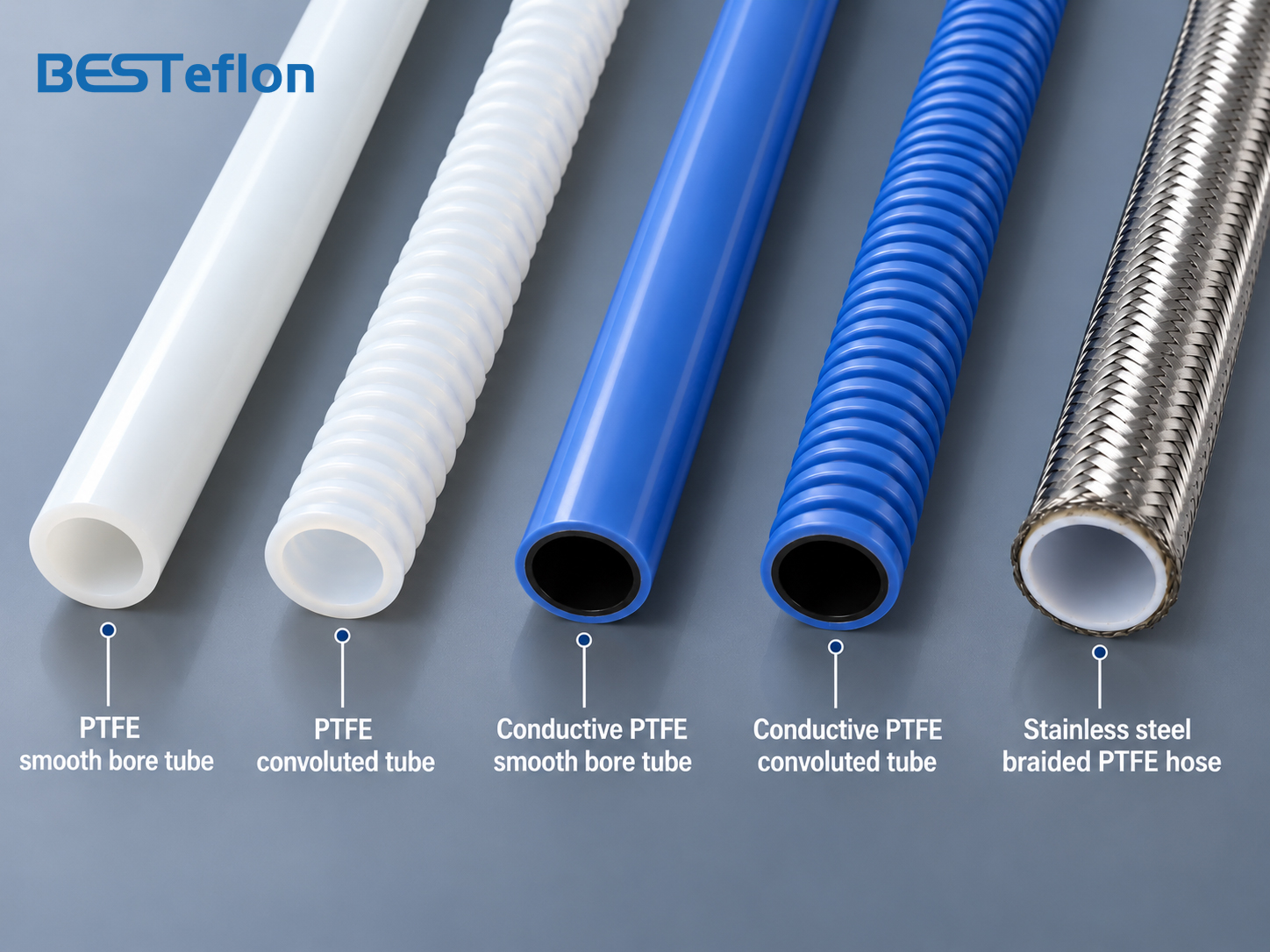
“PTFE tube” describes a material, but different structures are available for different operating conditions.
Smooth Bore PTFE Tube
A smooth bore PTFE tube is often suitable when you need:
- ·Good flow characteristics
- ·Easy cleaning
- ·Chemical resistance
- ·High purity
- ·Straight or moderately curved routing
It is widely used in laboratory equipment, chemical dosing, analytical instruments, industrial machinery, and fluid-transfer systems.
PTFE Convoluted Tube
A convoluted tube is useful when installation space is limited or the tubing needs greater flexibility.
The corrugated structure allows a smaller bending radius and can help prevent kinking in tight routing areas.
Stainless Steel Braided PTFE Hose
If the application involves higher pressure, vibration, mechanical stress, or demanding industrial environments, a stainless steel braided PTFE hose may be more appropriate.
The PTFE inner tube provides chemical resistance while the stainless steel braid provides mechanical reinforcement.
Conductive PTFE Tube
Conductive PTFE should be considered when transferring fluids that may generate electrostatic charge, particularly certain fuels, solvents, or high-flow media.
The correct structure depends on much more than chemical resistance alone.
What Information Should I Give a PTFE Tube Supplier Before Ordering?
If you contact a supplier and simply ask:
“Do you have chemical-resistant PTFE tubing?”
you may receive a product recommendation, but not necessarily the correct one.
A better inquiry would provide the actual application conditions.
Before requesting a quotation, prepare the following information:
1. Chemical / fluid: What will flow through the tube?
2. Concentration: For example, 10%, 50%, or concentrated acid.
3. Operating temperature: Normal and maximum temperature.
4. Working pressure: Normal and maximum system pressure.
5. Tube ID and OD: Or required flow rate if the dimensions are not yet determined.
6. Installation: Straight, tight bends, continuous movement, vibration, etc.
7. Environment: Indoor, outdoor, high-temperature zone, cleanroom, etc.
8. Conductivity requirement: Is antistatic/conductive PTFE required?
9. Connection: Bare tubing or complete hose assembly with fittings?
10. Quantity: Prototype, small batch, or mass production.
This information allows an experienced PTFE tubing manufacturer to evaluate the complete application rather than simply confirming chemical compatibility.
How Can I Check Whether PTFE Is Compatible With My Specific Chemical?
A chemical resistance chart is a useful starting point, but it should not be the final engineering decision for critical applications.
A practical selection process is:
Step 1 — Identify the exact chemical.
Do not use general descriptions such as “cleaning fluid” or “solvent.”
Step 2 — Confirm concentration.
The same chemical may be used at very different concentrations.
Step 3 — Confirm temperature.
Chemical compatibility at room temperature does not automatically represent performance at elevated temperatures.
Step 4 — Confirm pressure and mechanical conditions.
Chemical resistance alone does not determine the required wall thickness or reinforcement.
Step 5 — Consider permeability and purity requirements.
These may be important in semiconductor, laboratory, pharmaceutical, food-processing, fuel, and high-purity applications.
Step 6 — Verify the complete system.
Check fittings, seals, valves, reinforcement, and other wetted components—not only the PTFE tube.
For unusual chemical mixtures or severe operating conditions, sample testing under actual working conditions is often the safest approach.
Why Choose Besteflon for Chemical-Resistant PTFE Tubing?
Chemical compatibility is only one part of choosing a PTFE tube.
The next question is whether the manufacturer can provide the correct dimensions, structure, reinforcement, fittings, and customization for your application.
Besteflon have over 20 years experience of specializing in PTFE tubing and hose solutions for industrial fluid-transfer applications, including:
- ·Smooth bore PTFE tubes
- ·PTFE convoluted tubes
- ·Stainless steel braided PTFE hoses
- ·Conductive / antistatic PTFE options
- ·Custom tube sizes
- ·Custom outer covers
- ·PTFE hose assemblies
- ·Fitting solutions
- ·OEM / ODM production
For buyers replacing an existing tube, drawings or physical samples can also help determine the appropriate PTFE replacement.
Rather than selecting a tube based only on material name, Besteflon can evaluate the fluid medium, temperature, pressure, dimensions, bending requirements, and installation environment to help identify a more suitable solution.
Frequently Asked Questions About PTFE Tube Chemical Resistance
Is PTFE resistant to hydrochloric acid?
Yes. PTFE generally has excellent resistance to hydrochloric acid and is commonly considered for applications involving corrosive acidic media.
Is PTFE resistant to sulfuric acid?
Yes. PTFE generally provides excellent resistance to sulfuric acid across a broad range of concentrations. Actual operating temperature, pressure, and system design should still be evaluated.
Can PTFE tubing be used with acetone?
PTFE generally has excellent compatibility with acetone and many other organic solvents.
Can PTFE tubing handle ethanol and IPA?
Yes. PTFE is generally highly resistant to ethanol, isopropyl alcohol (IPA), and many other alcohols.
Is PTFE suitable for sodium hydroxide?
PTFE generally provides excellent resistance to sodium hydroxide and many other strong alkaline solutions.
Can PTFE tubing be used for fuel?
PTFE is compatible with many fuels and hydrocarbons. For applications where fluid flow may generate static electricity, conductive PTFE tubing should be considered. Besteflon has a series of PTFE hoses specially designed for automotive fuel lines.
Is PTFE better than PVC for chemical transfer?
For highly corrosive chemicals, solvents, or elevated-temperature applications, PTFE generally provides broader chemical resistance and higher temperature capability than PVC. PVC can still be a cost-effective choice for less demanding applications.
Is PTFE better than rubber tubing for chemicals?
It depends on the chemical and application. Rubber compounds vary significantly in chemical resistance. PTFE provides a much broader range of chemical compatibility and is particularly attractive when one system handles multiple aggressive chemicals.
Does PTFE tubing degrade over time?
PTFE has excellent aging and chemical stability. However, service life still depends on temperature, pressure, mechanical stress, permeation, installation, and other operating conditions.
Can I send my existing tube to a manufacturer for a PTFE replacement?
Yes. If you are replacing an existing rubber, PVC, nylon, silicone, metal, or other tube, providing the original tube specifications, drawings, samples, and operating conditions can help determine whether PTFE is a suitable replacement.
Conclusion: Is PTFE the Right Tubing Material for Your Chemical?
For most conventional industrial acids, alkalis, solvents, alcohols, oils, fuels, and aggressive process fluids, PTFE offers one of the broadest chemical resistance ranges among commonly used tubing materials.
But choosing the right tube involves more than asking:
“Can PTFE resist this chemical?”
The better question is:
“Can this PTFE tube safely handle this chemical at my concentration, temperature, pressure, and operating conditions?”
If your current tubing is swelling, cracking, hardening, corroding, or requiring frequent replacement, switching to PTFE may provide a longer-lasting and more reliable solution.
For new applications, provide your chemical name, concentration, operating temperature, pressure, required dimensions, and installation conditions before selecting the tube.
Need Help Checking Your Chemical?
If you are unsure whether PTFE tubing is suitable for your fluid, send Besteflon the chemical name, concentration, temperature, pressure, and required tube size.
Our team can help evaluate the application and recommend a suitable PTFE tube, convoluted tube, braided hose, or customized solution.
Send Your Chemical & Application Details → Get a PTFE Tubing Recommendation
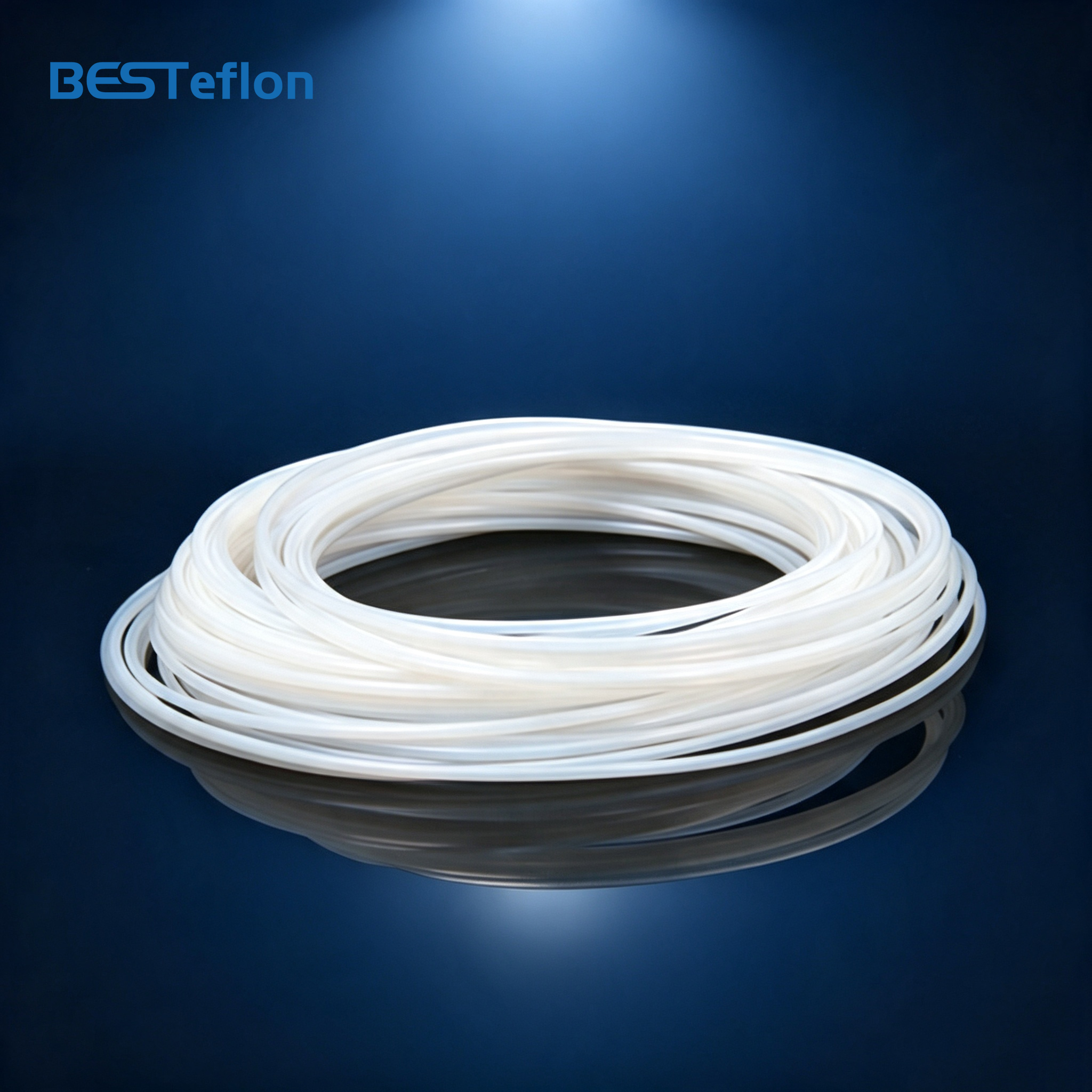
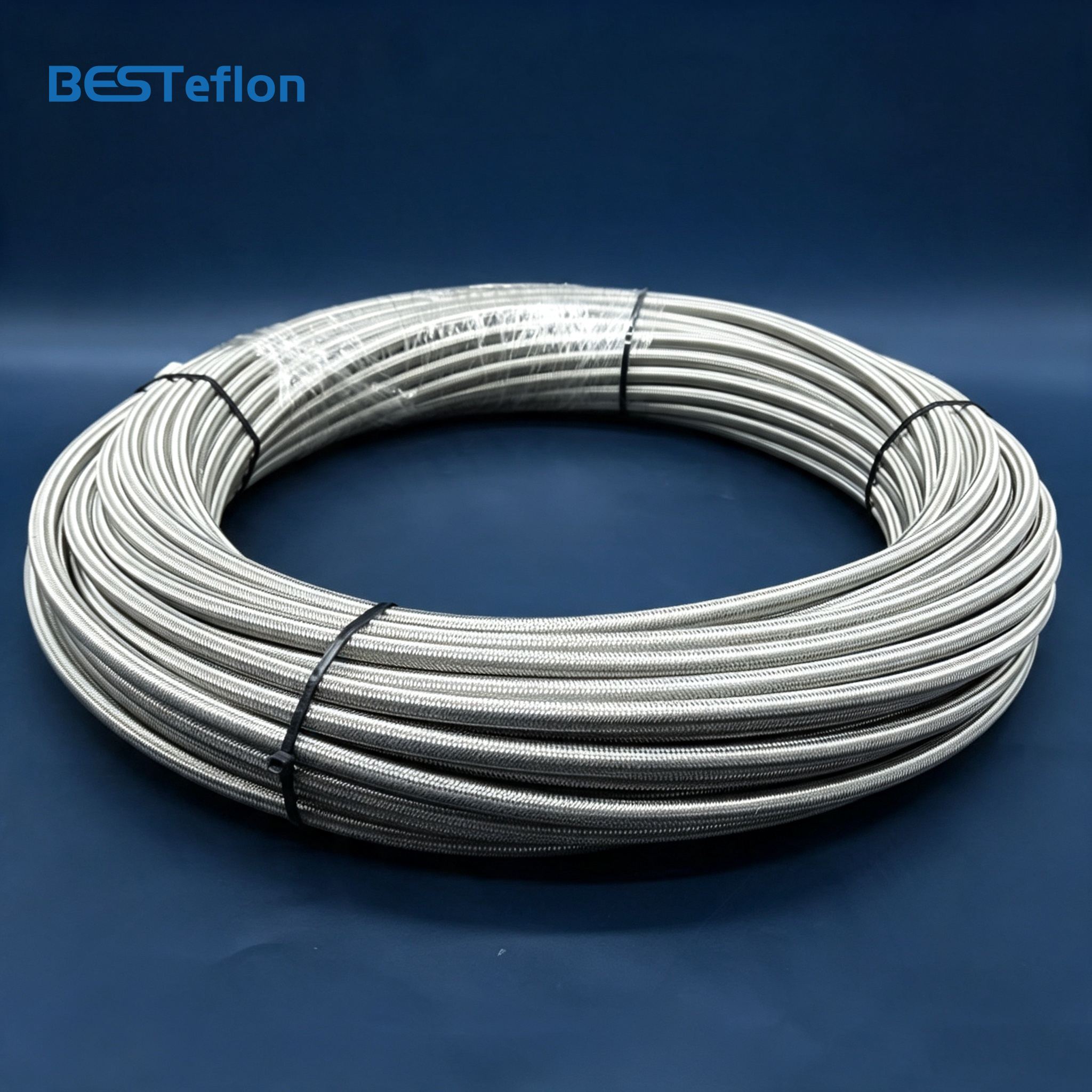
Buying the right PTFE Tube is not only about choosing different specifications for different applications. More to choose a reliable manufacturer. Besteflon Fluorine plastic Industry Co., Ltd. specializes in the production of high-quality PTFE hoses and tubes for 20 years. If any questions and needs, please feel free to consult us for more professional advice.
Post time: Sep-04-2026