
What is PTFE?
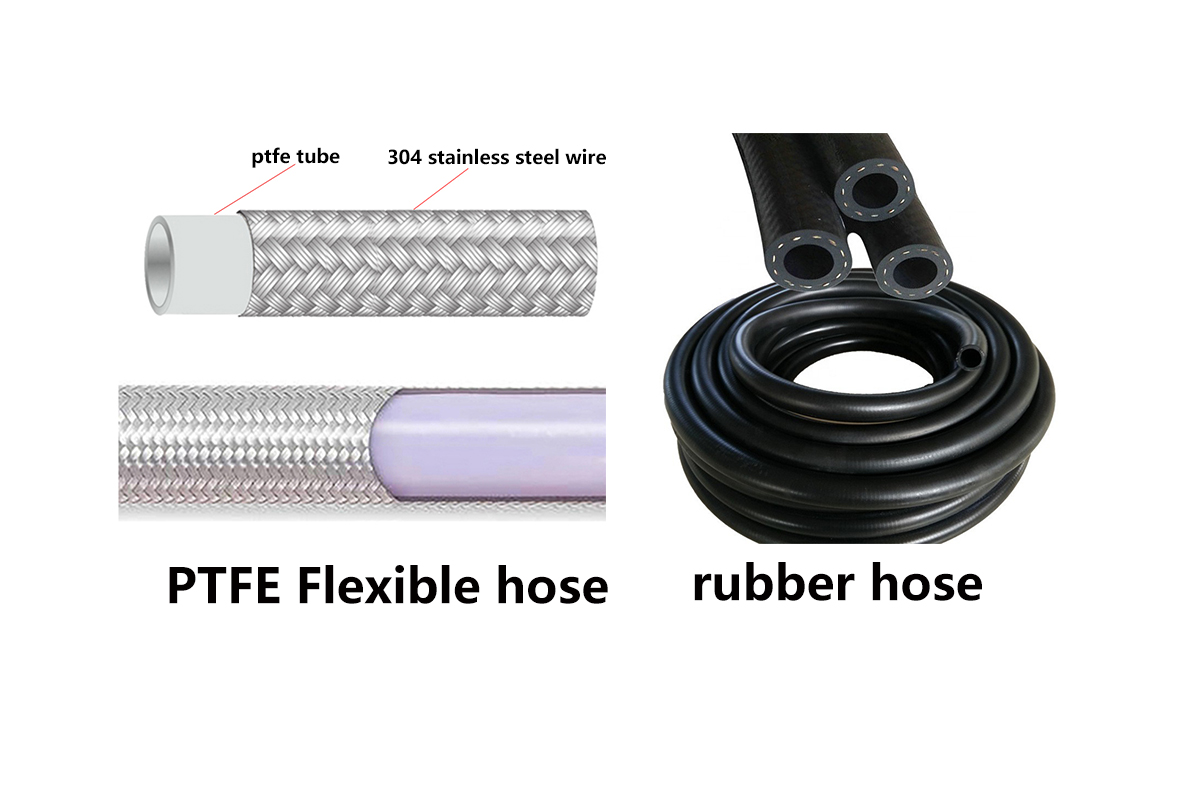
Polytetrafluoroethylene (PTFE) is a high-performance fluoropolymer known for its exceptional chemical inertness and thermal stability. PTFE flexible hoses feature a smooth, non-stick liner that resists almost all chemicals, making them ideal for harsh environments. The fluoropolymer properties provide a wide operating temperature range, typically from -200°C up to +260°C, and outstanding resistance to corrosion and permeation. This makes PTFE hoses a top choice for chemical-resistant hose applications, food and pharmaceutical industries, and high-temperature or high-pressure flexible hose needs.
What are Rubber Hoses?
Rubber hoses come in natural and synthetic forms, each suited for specific uses. Natural rubber offers good elasticity and abrasion resistance but limited chemical and temperature tolerance. Synthetic variants like nitrile (NBR) and EPDM enhance properties: nitrile excels in oil and fuel resistance, while EPDM is favored for weather, ozone, and heat resistance. Rubber hoses are usually constructed with multiple layers—inner rubber tubes, textile or steel reinforcements, and outer rubber covers—to balance flexibility, pressure capacity, and durability. However, their chemical resistance and temperature range are narrower compared to PTFE hose options.
Key Structural Differences
The primary structural distinction lies in the hose liner and reinforcement. PTFE flexible hoses have a smooth, inert PTFE liner surrounded by braided reinforcements made from stainless steel or synthetic fibers, providing high strength and pressure resistance. This construction ensures minimal permeation and excellent chemical compatibility. In contrast, rubber hoses use a rubber tube liner reinforced by fabrics or metal wire, which offers superior flexibility and abrasion resistance but lower chemical inertness and temperature resilience. These design variations define each hose type’s best application scenarios and operating limits.
Head-to-Head Comparison Table: PTFE Flexible Hose vs Rubber Hose
| Feature | PTFE Flexible Hose | Rubber Hose |
|---|---|---|
| Material Composition | Fluoropolymer (PTFE) liner with stainless steel braid or other reinforcements | Natural or synthetic rubber (Nitrile, EPDM), often with textile or wire braid |
| Operating Temperature | Wide range: -60°C to +260°C (High temperature hose) | Narrower range: -40°C to +120°C (varies by rubber type) |
| Working Pressure (WP) | High pressure capable: up to 100 bar or more depending on reinforcement | Moderate pressure: typically up to 20-30 bar |
| Chemical Resistance | Excellent chemical resistant hose; handles aggressive acids, solvents, and fuels | Limited chemical resistance; best for oils and mild chemicals |
| Flexibility & Bend Radius | Stiffer, larger bend radius, less flexible under tight conditions | Superior flexibility, smaller bend radius, easier to install |
| Permeation Resistance | Very low permeation, ideal for vapors, fuels, pharmaceuticals | Higher permeation rates, not suited for sensitive or hazardous fluids |
| Abrasion & Durability | High abrasion resistance and durable under harsh environments | Moderate abrasion resistance; tends to wear faster outdoors |
| Weight & Handling | Lightweight but less flexible; may require careful handling | Heavier but flexible and easier to manoeuvre during installation |
| Cost (Initial) | Higher upfront cost due to material and manufacture complexity | Lower initial cost, widely available, economical |
| Cost (Lifecycle) | Longer service life reduces replacement and maintenance cost | Shorter life leads to higher long-term maintenance expenses |
| Typical Service Life | 5 to 10+ years in demanding conditions | 2 to 5 years depending on environment and usage |
PTFE hoses lead in chemical resistance, temperature range, and durability.
Rubber hoses offer better flexibility, lower initial cost, and easier installation.
Choosing between PTFE flexible hose vs rubber hose depends largely on specific application needs such as pressure, temperature, chemical exposure, and budget.
Detailed Breakdown of Key Performance Factors
Chemical Resistance: PTFE vs Rubber
PTFE hoses stand out with near-universal chemical inertness thanks to their fluoropolymer structure. They resist aggressive acids, bases, and solvents without degrading, making PTFE flexible hoses ideal for corrosive chemical handling in industries like pharma and petrochemical. In contrast, rubber hoses—whether natural or synthetic types like nitrile or EPDM—have clear limits. For example, nitrile rubber struggles with strong acids and oils, while EPDM fares poorly against hydrocarbons. This difference means rubber hoses can fail or swell with incompatible fluids, costing you on downtime and replacements.
Temperature Performance
When it comes to temperature range, PTFE hoses operate smoothly from about -70°C up to 260°C or higher. This broad working temperature range supports high-temperature process lines and cold storage alike. Rubber hoses typically handle a narrower band, around -40°C to 120°C, which restricts their use in extreme heat or freezing conditions. If your process involves wide or harsh temperature swings, PTFE hoses offer peace of mind.
Pressure Handling and Reinforcements
PTFE hoses often feature braided stainless steel reinforcements, boosting working pressure capabilities far beyond typical rubber hoses. This makes PTFE braided hoses the go-to for high-pressure flexible hose needs in critical sectors like aerospace and fuel delivery. Rubber hoses rely on textile or steel wire reinforcements too but generally can’t match PTFE’s strength-to-weight ratio or durability under constant high pressure.
Flexibility and Installation Tips
Rubber hoses shine with superior flexibility and a smaller bend radius, easing installation in tight spaces or complex layouts. PTFE hoses tend to be stiffer and require careful handling during fitting. However, PTFE’s smooth inner liner reduces friction and improves flow, partially compensating for this. For installations needing tight bends with chemical resistance, consider hybrid options like PTFE-lined rubber hoses.
Durability and Longevity
PTFE hoses resist aging, UV exposure, and ozone much better than rubber hoses, which can become brittle or crack over time. This durability translates to longer service life and fewer replacements, especially outdoors or harsh environments. Rubber hoses might need frequent inspections and swaps under such conditions, impacting operational costs.
Permeation and Cleanliness
PTFE’s dense fluoropolymer structure acts as an excellent vapor barrier, crucial for clean fuel transfer and pharmaceutical-grade applications. Rubber hoses generally have higher permeation rates, risking contamination or loss of volatile fluids. For industries requiring pristine cleanliness and low permeation, PTFE hoses are a clear winner.
Other Factors: Electrical Properties, Weight, Fittings
- Electrical Properties: PTFE is non-conductive and has high dielectric strength, beneficial for certain electrical insulation uses. Rubber varies by type but often offers some conductivity.
- Weight: Rubber hoses are bulkier and heavier, potentially complicating handling and installation. PTFE hoses, especially those with metal braid, strike a balance between strength and weight.
- Fittings Compatibility: Both hose types offer wide fittings availability, but PTFE hoses require secure fittings that accommodate their stiffness and inner liner to avoid leaks.
When you weigh chemical resistance, temperature range, pressure, flexibility, and durability, PTFE flexible hoses clearly excel in demanding environments, while rubber hoses remain practical for more general, cost-sensitive applications.
Pros and Cons of PTFE Flexible Hose vs Rubber Hose
When weighing your options between PTFE flexible hose and rubber hose, it helps to understand the key advantages and drawbacks of each.
PTFE Flexible Hose Advantages
- Outstanding chemical resistance: PTFE is highly inert, handling acids, solvents, and aggressive fluids without degrading.
- Wide temperature range: Works well from very low to extremely high temperatures (-200°C to +260°C), perfect for demanding applications.
- High pressure capability: PTFE hoses with braided reinforcement handle high working pressures reliably.
- Clean and non-contaminating: Ideal for pharmaceutical, food, and fuel systems because it doesn’t leach chemicals.
- Low permeation: Acts as a vapor barrier, minimizing leaks or outside contamination.
- Long service life: Resistant to aging, UV, ozone, and abrasion, reducing replacement frequency.
PTFE Flexible Hose Drawbacks
- Less flexible: Stiffer than rubber, making installation in tight bends trickier.
- Higher cost: Initial investment and fittings can be pricier compared to rubber hoses.
- Weight: Typically heavier than rubber hoses, affecting handling in some cases.
Rubber Hose Advantages
- Excellent flexibility: Easier to bend and install in confined spaces.
- Cost-effective: Lower upfront costs make rubber hoses budget-friendly for general service.
- Good abrasion resistance: Durable for many industrial uses involving rough handling.
- Variety: Available in natural and synthetic types (like nitrile, EPDM) to suit different needs.
Rubber Hose Drawbacks
- Limited chemical resistance: Vulnerable to oils, fuels, and aggressive chemicals compared to PTFE.
- Narrower temperature range: More prone to degradation outside moderate temperature limits (-40°C to +120°C typically).
- Aging issues: Rubber can deteriorate under UV light, ozone, or harsh environments.
- Higher permeation rates: Not ideal where vapor leak prevention is critical.
Both PTFE and rubber hoses have their place depending on your exact needs. PTFE flexible hoses excel in extreme conditions and critical contamination control, while rubber hoses win on cost and flexibility for general industrial use. Understanding these trade-offs helps pick the perfect hose for your application.
Application-Specific Recommendations for PTFE Flexible Hose vs Rubber Hose
Choosing between a PTFE flexible hose and a rubber hose depends heavily on your specific application and operating conditions. Here’s a simple guide to help you decide:
When to Choose PTFE Flexible Hoses
- Corrosive Chemicals: PTFE hoses excel with strong acids, bases, and solvents due to their superior chemical resistance and inertness.
- Extreme Temperatures and Pressures: If you’re dealing with very high or low temperatures or high-pressure systems, PTFE flexible hoses handle a wider operating temperature range and higher working pressures without degradation.
- Food and Pharmaceutical Industries: PTFE’s non-contaminating, vapor barrier properties make these hoses ideal for food processing, pharma, and biotech applications.
- Fuel Systems: PTFE hoses resist fuel permeation and maintain cleanliness, critical for automotive, aerospace, and defense sectors.
- Aerospace: When lightweight, durable, and corrosion-resistant hoses are mandatory, PTFE flexible hoses meet strict ISO 9001 standards ensuring quality and traceability.
When Rubber Hoses Make More Sense
- General Industrial Use: For standard fluid transfer, air lines, and moderate chemical exposure, rubber hoses offer ample flexibility and durability.
- Cost-Sensitive Projects: Rubber hoses typically have a lower upfront cost than PTFE braided hoses, making them attractive for budget-constrained operations.
- High Flexibility Needs: In tight spaces or where frequent bending is required, rubber hoses handle sharp bend radii better than the stiffer PTFE liners.
- Moderate Temperatures and Pressures: For applications within typical temperature ranges and working pressures, rubber hoses provide reliable performance without the premium price.
Hybrid Solutions: PTFE-Lined Rubber Hoses
- Sometimes, a combination works best. PTFE-lined rubber hoses provide:These hybrid hoses are popular in environments demanding chemical resistance with higher flexibility, balancing cost and performance.
- The chemical resistance and cleanliness of PTFE inside.
- The flexibility and abrasion resistance of rubber outside.
By matching hose choice to application specifics—whether it’s harsh chemical transfer or flexible general use—you can optimize durability, safety, and budget. For demanding environments, PTFE flexible hoses are a reliable investment, while rubber hoses remain practical for everyday industry needs.
Compliance, Standards, and Quality Considerations
When picking between PTFE flexible hoses and rubber hoses, compliance and quality standards matter a lot, especially for safety-critical industries. ISO 9001 certification is a key sign that a manufacturer runs a solid quality management system. This means consistent product quality, rigorous testing, and documentation you can trust.
Testing and certifications go beyond just ticking boxes. For PTFE hoses, especially those used in extreme conditions like chemical processing or aerospace, traceability is crucial. Knowing the hose's full manufacturing and inspection history helps prevent failures and ensures safety.
BESTEFLON, a leader in premium PTFE hoses, emphasizes these quality benchmarks. Their hoses are designed and tested to meet tough industry standards, making them a safe choice for demanding environments. From corrosion resistance to high pressure and temperature tolerance, BESTEFLON’s PTFE braided hoses deliver reliable performance backed by top-notch compliance and quality control.
Cost Analysis: Initial vs. Total Ownership
When weighing PTFE flexible hose vs rubber hose, the upfront cost is usually where rubber hoses win. Rubber hoses tend to be cheaper to buy initially due to simpler materials and manufacturing processes. PTFE braided hoses, made from specialized fluoropolymer, come with a higher price tag because of their advanced chemical resistance and high-temperature capabilities.
However, if you zoom out and look at the total cost of ownership, PTFE hoses often save you money over time. Here’s why:
- Fewer replacements: PTFE’s durability and resistance to abrasion, chemicals, and extreme temperatures mean it lasts much longer than rubber hoses.
- Lower maintenance: Because PTFE hoses don’t degrade easily from ozone, UV, or chemicals, you spend less time and money on repairs or preventative upkeep.
- Less downtime: In industries like pharmaceuticals, aerospace, or chemical processing, hose failure can halt operations. Using PTFE flexible hoses reduces these risks due to their higher reliability.
- Better performance in harsh environments: PTFE hoses handle high pressure and wide temperature ranges better, avoiding the need for frequent hose swaps or upgrades.
In , while rubber hoses might look attractive cost-wise at first, PTFE hoses deliver better value in the long run, especially for critical applications demanding chemical resistance, durability, and operating temperature range. For businesses focused on reducing operational costs and enhancing safety, investing in premium PTFE hoses is a smart choice.
Why BESTEFLON is the Ultimate Choice for Your Fluid Transfer Needs
When navigating the complexities of PTFE Flexible Hose vs. Rubber Hose, the choice ultimately comes down to reliability and the "Total Cost of Ownership." While rubber provides a short-term, budget-friendly fix, BESTEFLON PTFE hoses represent a long-term investment in safety and operational efficiency.
Why trust BESTEFLON?
Uncompromising Material Purity: We utilize premium, virgin PTFE resins that provide near-universal chemical inertness and a staggering temperature tolerance from -200°C to +260°C.
Superior Engineering: Our hoses feature high-tensile stainless steel braiding and advanced crimping techniques, ensuring our high-pressure flexible hoses exceed industry standards for burst pressure and safety.
Certified Quality & Traceability: Operating under strict ISO 9001 benchmarks and FDA, every BESTEFLON product is fully traceable, providing peace of mind for critical applications in the aerospace, pharmaceutical, and chemical sectors.
Maximum Durability: By eliminating common failure points like EPDM degradation, UV cracking, and high permeation, BESTEFLON hoses significantly reduce maintenance intervals and costly downtime.
In demanding environments where failure is not an option, BESTEFLON delivers the performance of a race-grade component with the durability of an industrial powerhouse. Upgrade to the BESTEFLON standard—where precision engineering meets extreme resilience.
Buying the right PTFE Flexible Hoses is not only about choosing different specifications for different applications. More to choose a reliable manufacturer. Besteflon Fluorine plastic Industry Co., Ltd. specializes in the production of high-quality PTFE hoses and tubes for 20 years. If any questions and needs, please feel free to consult us for more professional advice.
If you are in PTFE Flexible Hose,You May Like
Post time: Feb-25-2026